




AI agentic workflows and permission controls: the precise research question
Direct answer. How should agentic legal workflows constrain access, tool permissions and human approvals? A defensible reference begins by identifying the object being examined and the decision it is supposed to support. In this guide the working boundary is Technical workflow governance, not an unapproved AI-agent product offer.. Define what an AI agent may read, draft, submit or alter, and introduce authorization checks before consequential actions. The question is neither a request for a universal legal opinion nor an assertion that an unsourced patent corpus has already been measured. The reader should know which official documents will be consulted, what the proposed research can establish, and which conclusions are expressly outside the evidence available here.
The first analytical distinction is between what a record says, what the researcher infers, and what a decision-maker may ultimately decide. A technical approval step does not replace local professional duties or contractual security requirements. A report that fails to keep those categories separate may look complete while failing to answer the actual task. Each subsequent step therefore has a named output and an explicit uncertainty field, not an assurance of a legal or commercial result.
Primary authorities and their actual role
Official evidence. NIST AI 600-1 provides voluntary risk-management considerations for generative AI, not statutory legal obligations. The relevant reference entry point is NIST Generative AI Profile, NIST AI 600-1. This statement applies to the scope of that source and should not be read as a verified conclusion about a particular patent, product, client or national register. ABA Formal Opinion 512 discusses US lawyer competence, confidentiality, supervision, candor and communication when using generative AI; local rules may differ. The second independent starting point is ABA Formal Opinion 512 — AI tools in legal practice. Both sources must be read in their own context and checked for later updates before high-consequence use.
For this particular question, the source selection changes the conclusion. A classification scheme establishes available subject categories; a patent-publication portal reports documents; a prosecution file reports recorded procedural acts; and a professional guidance document describes standards within its stated jurisdiction. These source types do not substitute for each other. Separate read-only evidence retrieval from external transmission and irreversible filing operations. When an official primary record is unavailable, the correct status is “unverified”, not a confident assumption borrowed from a general search summary.
Worked example: an explicitly hypothetical investigation
Illustrative scenario — not an observed case or search result. An agent drafts a patent search memorandum but must not submit an official filing or send confidential material without a permitted human action. The analyst first writes the technical and documentary question in one sentence, identifies the period and the patent-office or technical corpus, and then creates an evidence ledger. Tool permission, data category, trigger, audit log, reviewer and rollback. The report records not just a source URL but the exact document, publication or record identifier, its relevant date, and the page, claim or paragraph where the observation appears.
The example should be resolved into alternative hypotheses before selection: perhaps the terminology is different in older documents; perhaps the technical function appears in a neighboring field; perhaps an earlier family member is available; or perhaps the legal-status field is not current. A null result under one set of search fields remains a search observation. It does not logically establish that the subject is new, clear for launch, invalid, valuable or free of competing claims. The researcher should show which reasonable alternative would change the result and what evidence could test it.
Research steps and decision checkpoints
- Scope: Define the exact technology, record or question; identify the applicable jurisdiction and decision date.
- Source: Choose an authoritative primary source matched to that question, recording its portal, edition or publication version.
- Search: Run a recorded combination of terms, identifiers, dates or classification routes with a stated search boundary.
- Inspect: Read the underlying document and relevant paragraphs, claims, illustrations or event records rather than only the result snippet.
- Challenge: Run a deliberate alternative or contrary check, including adjacent categories, languages, older versions and conflicting records.
- Report: Separate verified observations, analytical interpretation and unresolved issues, preserving enough information for another reviewer to reproduce the procedure.
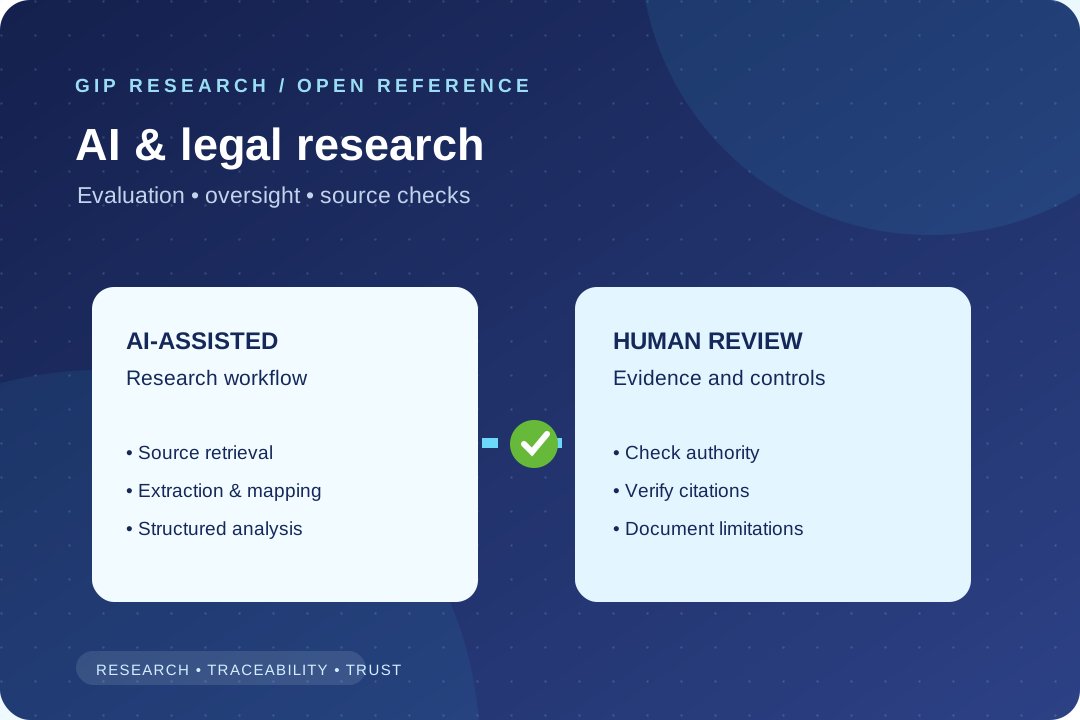
For AI agentic workflows and permission controls, the practical checkpoint is especially important: Separate read-only evidence retrieval from external transmission and irreversible filing operations. A one-pass query without a documented revision history can produce attractive examples while missing the technical variants relevant to the research question. Keep both inclusion and exclusion reasons, and preserve rejected search terms when they reveal how the working hypothesis changed. The resulting workflow is an editorial recommendation, not a rule imposed by every patent office.
Original evidence-to-decision comparison
| Assessment dimension | Evidence or question | Quality control |
|---|---|---|
| Primary object | Tool permission, data category, trigger, audit log, reviewer and rollback. | Record the authoritative original; do not infer from an abbreviated title. |
| Differentiating check | Separate read-only evidence retrieval from external transmission and irreversible filing operations. | Explain the decision affected by this comparison. |
| Contrary case | A technical approval step does not replace local professional duties or contractual security requirements. | Name the uncertainty or route that could reverse the interpretation. |
| Reproducibility | Agent permission/access matrix | Use an identified source and dated method, not unobserved numerical results. |
How to use the matrix. Populate entries with actual documents before declaring the investigation complete; a conceptual comparison is not evidence that a database query or professional investigation was performed. The proposed agent permission/access matrix identifies the first information product, while risk-to-control map for publish/send/upload decisions is an independent check. If both are based on the same unverifiable assumption, they do not count as two independent evidence sources. This distinction protects readers from confusing a polished data table with a supported finding.
Temporal, jurisdictional and classification boundaries
Check the time stamp and scope of the relevant authority. Classification revisions, changes to office web interfaces, new application publications, and legal decisions can all affect what a researcher can observe. Where the issue is a national legal question, consult the applicable national authority instead of treating the WIPO or EPO global search result as a territorial finding. If it is a methodological comparison rather than a legal conclusion, identify it as a suggested research practice and explain why that method fits this particular question.
Edition and identity control matter as much as apparent relevance. Patent publications have numbers, application records have procedural histories, and technical publications may have preprint and final versions. A source is persuasive for a claim only when its identity and version match the proposition being made. The second authority, ABA Formal Opinion 512 — AI tools in legal practice, should be used for its documented field of competence rather than assumed universal coverage. When records conflict, preserve the conflict and state what authoritative additional check is needed.
Information gained from this reference
First synthesis. Agent permission/access matrix. This should be prepared as an auditable research instrument: state the unit of analysis, provide source columns, capture alternative terms and show why a classification or document was included. Second synthesis. Risk-to-control map for publish/send/upload decisions. Treat the second product as a challenge to the first one. A useful synthesis discloses ambiguity and negative findings rather than concealing them behind a confident recommendation.
An appropriate comparison shows how evidence changes a research decision: if a document is a mere family equivalent, count it as such; if a feature is not literally disclosed, do not silently mark it present; if a portal provides a published application without current territorial status, add a legal-status verification step. Define what an AI agent may read, draft, submit or alter, and introduce authorization checks before consequential actions. These examples describe what an analyst should investigate, not findings already made about an actual patent portfolio or an applicant.
Failure modes and cautious interpretation
A technical approval step does not replace local professional duties or contractual security requirements. A second danger is scope creep: the reader may ask a methodological page to answer whether a patent is valid, infringed or commercially valuable. Those questions need additional facts and, often, legal analysis under a specified jurisdiction. The absence of a source on a public portal also needs careful wording: the record may be unpublished, outside the database, known under a related identifier, translated differently, inaccessible or omitted because the query was too narrow.
To reduce these errors, review a sample of retrieved full records rather than trusting snippets, confirm negative assertions against a second source where practicable, and check whether the document version matches the stated date. Preserve contrary sources and explain their effect. When an authoritative rule is quoted or paraphrased, a dated official link should be close to the proposition rather than buried in an unrelated bibliography. This reference is information and methodology, not legal advice or an assurance of completeness.
Reproducibility checklist and next-step decision
- Research question and intended use clearly stated.
- Source authority, version, country or institution, and retrieval date recorded.
- Terms, fields, identifiers, classifications, translations and exclusions preserved.
- Original documents reviewed where important, not only summaries.
- Conflicting material and uncertainty made visible rather than discarded.
- Proposed next question and specialist review threshold stated.
For further investigation, the site’s adjacent reference hubs provide the definitions and procedural background. Use this method alongside the actual source record, not as a substitute for one. If the work will inform a filing, launch, investment, rights assertion, legal advice or confidential client document, a qualified reviewer should check the underlying legal and technical materials. The scope set out here is therefore deliberately narrower than a commissioned opinion, and any example remains illustrative until supported by an independently checked record.
Appropriate follow-up pathways beyond this reference
This page is deliberately a general reference. If the reader has moved from understanding evidence and method to a live engagement question, the adjacent portfolio provides distinct starting points: AdvocateRahulDev.com for AI-enabled legal research and professional workflow application; TechCorpLegal for technology law and compliance questions that extend beyond a research method. These are contextual research pathways rather than endorsements, guarantees or a substitute for independent selection of qualified advice. Readers should verify the current applicability, engagement terms and jurisdiction before relying on a professional service.
Official starting points and source limitations
Primary source entry points checked for this editorial revision: NIST Generative AI Profile, NIST AI 600-1 ABA Formal Opinion 512 — AI tools in legal practice. These links identify reference materials, not evidence that every hypothetical step has been executed. Official guidance may change after the stated reference edition; page-specific update triggers and further checks are maintained in the accompanying editorial register.