





Training researchers to challenge AI outputs
A research-team learning plan should use authentic task categories rather than a generic prompt-engineering course: identify a primary legal source, locate its effective version, distinguish quoted law from interpretation, and document a model’s unsupported assertion. Separate performance on patent identifiers from contract clauses and regulatory dates so a single aggregate score cannot hide harmful failures.
What the retrieved evidence can and cannot establish
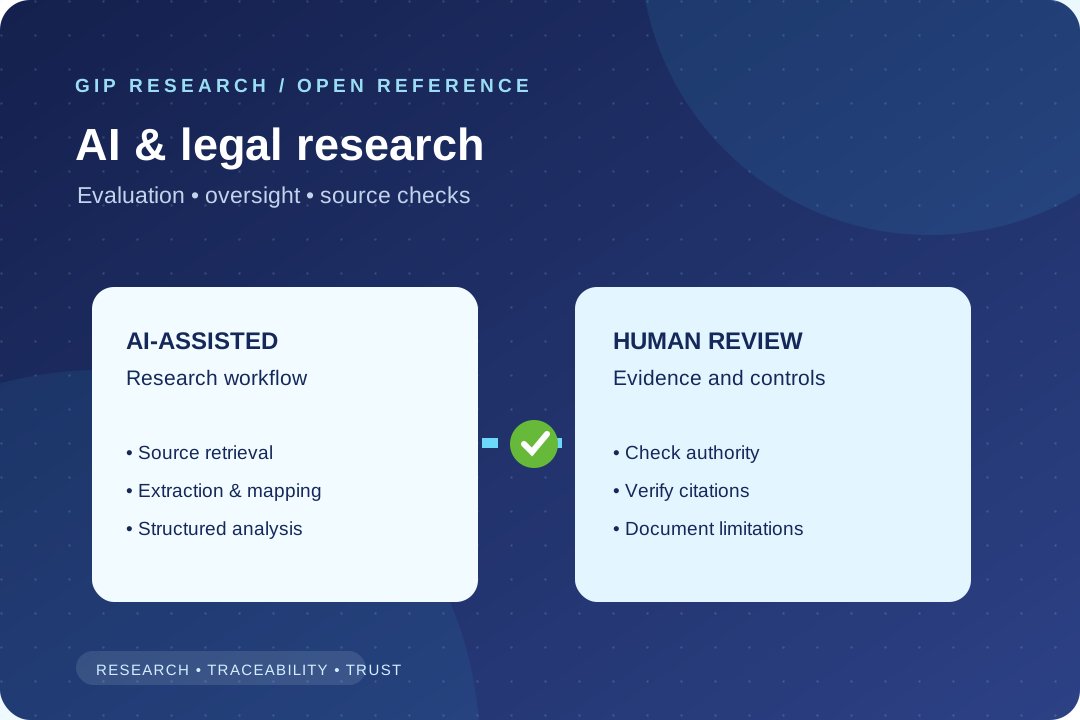
Use a pre-training and post-training evaluation with the same scoring rubric but different unseen examples. Assess citation correctness, detection of omissions, handling of contradictory material and readiness to escalate to qualified professionals. Report sample size and grader agreement; avoid claiming proficiency from attendance or self-reported confidence.
AI Research Methods and Team Training — research scope and evidence
This reference sets out an evidence-driven approach to ai research methods and team training. It describes potential research methods and the limits of their use; it does not report a commissioned assessment or a verified service commitment.
Research control 1: Set separate curricula for search analysts, paralegal researchers, technical reviewers and supervisors
The substantive test is to set separate curricula for search analysts, paralegal researchers, technical reviewers and supervisors. An analyst should identify the source required, state a falsifiable failure condition, and describe how a reviewer would confirm or dispute the result. A useful evidence row contains the item under examination, controlling record, selected passage, competing interpretation, current disposition and person responsible for resolution. If any of those fields is unknown, the output should disclose that gap rather than fill it by extrapolation. The test should be repeatable when new documents arrive or the governing source is amended.
Research control 2: Teach participants to trace each material conclusion to a primary record before using assisted summaries
The substantive test is to teach participants to trace each material conclusion to a primary record before using assisted summaries. An analyst should identify the source required, state a falsifiable failure condition, and describe how a reviewer would confirm or dispute the result. A useful evidence row contains the item under examination, controlling record, selected passage, competing interpretation, current disposition and person responsible for resolution. If any of those fields is unknown, the output should disclose that gap rather than fill it by extrapolation. The test should be repeatable when new documents arrive or the governing source is amended.
Research control 3: Compare baseline and post-training performance on the same blinded research cases
The substantive test is to compare baseline and post-training performance on the same blinded research cases. An analyst should identify the source required, state a falsifiable failure condition, and describe how a reviewer would confirm or dispute the result. A useful evidence row contains the item under examination, controlling record, selected passage, competing interpretation, current disposition and person responsible for resolution. If any of those fields is unknown, the output should disclose that gap rather than fill it by extrapolation. The test should be repeatable when new documents arrive or the governing source is amended.
Research control 4: Require data-handling exercises covering confidentiality, retention and externally hosted model inputs
The substantive test is to require data-handling exercises covering confidentiality, retention and externally hosted model inputs. An analyst should identify the source required, state a falsifiable failure condition, and describe how a reviewer would confirm or dispute the result. A useful evidence row contains the item under examination, controlling record, selected passage, competing interpretation, current disposition and person responsible for resolution. If any of those fields is unknown, the output should disclose that gap rather than fill it by extrapolation. The test should be repeatable when new documents arrive or the governing source is amended.
Research control 5: Assess uncertainty disclosure when statutes, claims or procedural records conflict
The substantive test is to assess uncertainty disclosure when statutes, claims or procedural records conflict. An analyst should identify the source required, state a falsifiable failure condition, and describe how a reviewer would confirm or dispute the result. A useful evidence row contains the item under examination, controlling record, selected passage, competing interpretation, current disposition and person responsible for resolution. If any of those fields is unknown, the output should disclose that gap rather than fill it by extrapolation. The test should be repeatable when new documents arrive or the governing source is amended.
Research control 6: Maintain version-controlled training examples because model behaviour and source systems change
The substantive test is to maintain version-controlled training examples because model behaviour and source systems change. An analyst should identify the source required, state a falsifiable failure condition, and describe how a reviewer would confirm or dispute the result. A useful evidence row contains the item under examination, controlling record, selected passage, competing interpretation, current disposition and person responsible for resolution. If any of those fields is unknown, the output should disclose that gap rather than fill it by extrapolation. The test should be repeatable when new documents arrive or the governing source is amended.
Hypothetical case 1: how an error might change the conclusion
Imagine that a trainee must correct a hallucinated case citation without relying on the model to validate itself. This is an illustrative scenario, not a report of an actual client project. The right response is to isolate the source record and version, identify why the initial classification is unreliable, obtain a second independent review and revise the exception schedule. The decisive question is not whether the model can produce a persuasive paragraph; it is whether the relevant evidence can be retrieved and checked by someone who did not build the workflow.
Hypothetical case 2: how an error might change the conclusion
Imagine that a mixed team produces different patent-family counts using incompatible family definitions. This is an illustrative scenario, not a report of an actual client project. The right response is to isolate the source record and version, identify why the initial classification is unreliable, obtain a second independent review and revise the exception schedule. The decisive question is not whether the model can produce a persuasive paragraph; it is whether the relevant evidence can be retrieved and checked by someone who did not build the workflow.
Hypothetical case 3: how an error might change the conclusion
Imagine that an exercise requires identifying sensitive client names before placing text in an external tool. This is an illustrative scenario, not a report of an actual client project. The right response is to isolate the source record and version, identify why the initial classification is unreliable, obtain a second independent review and revise the exception schedule. The decisive question is not whether the model can produce a persuasive paragraph; it is whether the relevant evidence can be retrieved and checked by someone who did not build the workflow.
Proposed outputs and their boundaries
The following materials are possible research artifacts rather than guaranteed service offerings: Role-specific skill matrix; Scored evidence-verification exercises; Training version ledger; Supervisor sign-off criteria. The scope and format would depend on what evidence is available and what the requester actually needs to decide. A useful handoff explains which findings are documentary, which are interpretations, which require legal advice, and which fields have yet to be checked. An evidence-grounded request can be discussed through the Contact page, but no procurement, staffing or regulated-practice undertaking is implied by this reference.
Official reference and next research steps
Primary institutional entry point for verification: https://www.nist.gov/itl/ai-risk-management-framework. Consult the relevant original rules and documents for any time-sensitive or consequential conclusion. See also the parent reference hub and the site evidence policy.
Editorial verification note: this framework is not a case-specific finding; current office records, source permissions, jurisdictional law and professional obligations require confirmation for each actual matter.