





Training-data rights and model-asset lineage
Training-data assessment starts with the acquisition pathway of each corpus, not the mere presence of an open URL. Distinguish content ownership, database rights, contractual usage restrictions, privacy conditions, model-output provenance and permissions to redistribute a derived dataset. Keep third-party model weights and evaluation datasets in separate lineage records.
What the retrieved evidence can and cannot establish
A concrete test is to trace one training sample from intake record through cleaning, annotation, training use and downstream output. If a licence allows research access but not redistribution or commercial training, a dataset-level label saying “open” is inadequate. Flag legal interpretation for jurisdiction-specific review and do not infer blanket permissions from technical accessibility.
AI Assets, Training Data and Rights Research — research scope and evidence
This reference sets out an evidence-driven approach to ai assets, training data and rights research. It describes potential research methods and the limits of their use; it does not report a commissioned assessment or a verified service commitment.
Research control 1: Inventory the models, weights, prompts, datasets, embeddings, generated artifacts and access arrangements
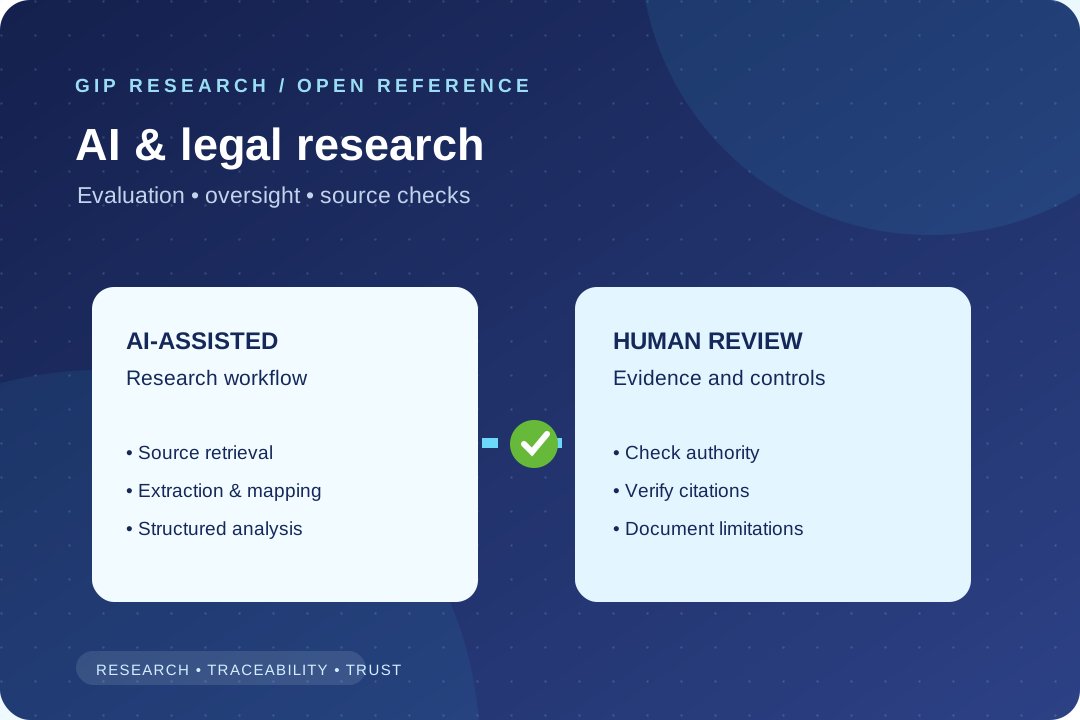
The substantive test is to inventory the models, weights, prompts, datasets, embeddings, generated artifacts and access arrangements. An analyst should identify the source required, state a falsifiable failure condition, and describe how a reviewer would confirm or dispute the result. A useful evidence row contains the item under examination, controlling record, selected passage, competing interpretation, current disposition and person responsible for resolution. If any of those fields is unknown, the output should disclose that gap rather than fill it by extrapolation. The test should be repeatable when new documents arrive or the governing source is amended.
Research control 2: Differentiate ownership claims from platform licences and factual control over model infrastructure
The substantive test is to differentiate ownership claims from platform licences and factual control over model infrastructure. An analyst should identify the source required, state a falsifiable failure condition, and describe how a reviewer would confirm or dispute the result. A useful evidence row contains the item under examination, controlling record, selected passage, competing interpretation, current disposition and person responsible for resolution. If any of those fields is unknown, the output should disclose that gap rather than fill it by extrapolation. The test should be repeatable when new documents arrive or the governing source is amended.
Research control 3: Record provenance and contractual restrictions for training and evaluation datasets
The substantive test is to record provenance and contractual restrictions for training and evaluation datasets. An analyst should identify the source required, state a falsifiable failure condition, and describe how a reviewer would confirm or dispute the result. A useful evidence row contains the item under examination, controlling record, selected passage, competing interpretation, current disposition and person responsible for resolution. If any of those fields is unknown, the output should disclose that gap rather than fill it by extrapolation. The test should be repeatable when new documents arrive or the governing source is amended.
Research control 4: Identify data-protection and confidentiality issues without presuming every dataset is personal data
The substantive test is to identify data-protection and confidentiality issues without presuming every dataset is personal data. An analyst should identify the source required, state a falsifiable failure condition, and describe how a reviewer would confirm or dispute the result. A useful evidence row contains the item under examination, controlling record, selected passage, competing interpretation, current disposition and person responsible for resolution. If any of those fields is unknown, the output should disclose that gap rather than fill it by extrapolation. The test should be repeatable when new documents arrive or the governing source is amended.
Research control 5: Review supplier disclosures, open-source terms and contractual warranties separately
The substantive test is to review supplier disclosures, open-source terms and contractual warranties separately. An analyst should identify the source required, state a falsifiable failure condition, and describe how a reviewer would confirm or dispute the result. A useful evidence row contains the item under examination, controlling record, selected passage, competing interpretation, current disposition and person responsible for resolution. If any of those fields is unknown, the output should disclose that gap rather than fill it by extrapolation. The test should be repeatable when new documents arrive or the governing source is amended.
Research control 6: Map unresolved copyright or database-right questions to relevant law and contract language
The substantive test is to map unresolved copyright or database-right questions to relevant law and contract language. An analyst should identify the source required, state a falsifiable failure condition, and describe how a reviewer would confirm or dispute the result. A useful evidence row contains the item under examination, controlling record, selected passage, competing interpretation, current disposition and person responsible for resolution. If any of those fields is unknown, the output should disclose that gap rather than fill it by extrapolation. The test should be repeatable when new documents arrive or the governing source is amended.
Hypothetical case 1: how an error might change the conclusion
Imagine that a supplier sells access to an API but the target lists the underlying model as its owned asset. This is an illustrative scenario, not a report of an actual client project. The right response is to isolate the source record and version, identify why the initial classification is unreliable, obtain a second independent review and revise the exception schedule. The decisive question is not whether the model can produce a persuasive paragraph; it is whether the relevant evidence can be retrieved and checked by someone who did not build the workflow.
Hypothetical case 2: how an error might change the conclusion
Imagine that a dataset contains material under differing redistribution and research-use restrictions. This is an illustrative scenario, not a report of an actual client project. The right response is to isolate the source record and version, identify why the initial classification is unreliable, obtain a second independent review and revise the exception schedule. The decisive question is not whether the model can produce a persuasive paragraph; it is whether the relevant evidence can be retrieved and checked by someone who did not build the workflow.
Hypothetical case 3: how an error might change the conclusion
Imagine that a development team cannot reconstruct the origin of a high-value fine-tuning corpus. This is an illustrative scenario, not a report of an actual client project. The right response is to isolate the source record and version, identify why the initial classification is unreliable, obtain a second independent review and revise the exception schedule. The decisive question is not whether the model can produce a persuasive paragraph; it is whether the relevant evidence can be retrieved and checked by someone who did not build the workflow.
Proposed outputs and their boundaries
The following materials are possible research artifacts rather than guaranteed service offerings: AI asset rights inventory; Data provenance exceptions; Licence and usage restriction matrix; Unresolved legal questions register. The scope and format would depend on what evidence is available and what the requester actually needs to decide. A useful handoff explains which findings are documentary, which are interpretations, which require legal advice, and which fields have yet to be checked. An evidence-grounded request can be discussed through the Contact page, but no procurement, staffing or regulated-practice undertaking is implied by this reference.
Official reference and next research steps
Primary institutional entry point for verification: https://www.wipo.int/en/web/wipolex. Consult the relevant original rules and documents for any time-sensitive or consequential conclusion. See also the parent reference hub and the site evidence policy.
Editorial verification note: this framework is not a case-specific finding; current office records, source permissions, jurisdictional law and professional obligations require confirmation for each actual matter.